
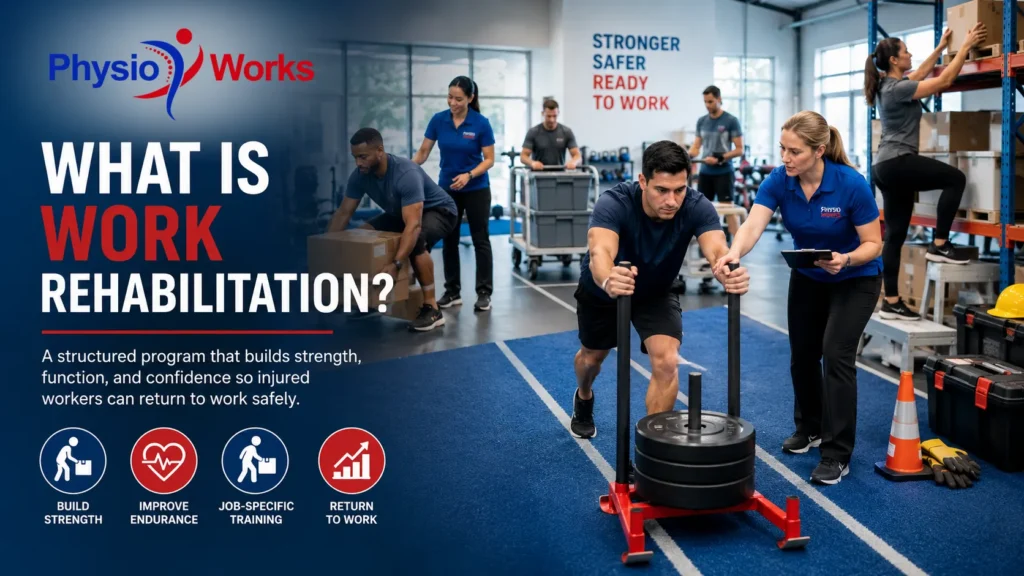
What Is Work Rehabilitation?
Washington Injured Worker Guide.
After a work injury, many people want the same thing: to recover and achieve a safe return to work. While traditional physical therapy is excellent for reducing pain, restoring basic movement, and improving baseline strength , some injured workers reach a point where they need a more job-specific program before they are truly ready for full-duty tasks.
If you are progressing well but still find yourself physically unable to meet the daily demands of your job, LNI Work Rehabilitation often referred to as work conditioning or work hardening are designed to bridge that exact gap.
Here is a comprehensive look at how L&I work rehab functions as a structured return-to-work program to help you build the strength, endurance, and confidence needed to get back on the job safely.
Training Camp for the Injured “Industrial Athlete“
At PhysioWorks, we often describe Work Rehabilitation as a training camp for the injured industrial athlete.
Think about it this way: a professional sports player would never jump straight back into a high-stakes competition immediately after an injury without sport-specific conditioning. In the exact same way, workers with physically demanding roles require job-specific conditioning before returning to full duty. This includes:
- Warehouse workers and delivery drivers
- Carpenters, mechanics, and laborers
- Nurses, caregivers, and healthcare workers
- May also include more sedentary jobs like office manger depending on the injury
The ultimate goal of Work Rehabilitation is not simply to improve symptoms in a controlled therapy setting, but to build the strength, endurance, and confidence needed to safely return to work. Physioworks builds a program to systematically prepare your body for real world workplace demands, such as heavy lifting, carrying, pushing, pulling, bending, climbing, and tolerating a full, rigorous workday.
What Is the Goal?
The primary goal is to help an injured worker:
- Recover physical function
- Improve strength, endurance, and mobility
- Safely perform job-specific tasks
- Return to work as soon as medically appropriate
- Reduce the risk of reinjury
- Build the injured worker’s confidence and functional ability to safely return to the job of injury at full duty.
The goal is not simply to feel better in the clinic. The goal is to prepare for real work demands such as lifting, carrying, pushing, pulling, bending, standing, walking, kneeling, climbing, reaching, and tolerating a full workday.
Who Might Need Work Rehabilitation?
Workers recovering from:
- Back injuries
- Neck injuries
- Shoulder injuries
- Repetitive strain injuries
- Hand and wrist injuries
- Surgery related to a workplace injury
- Complex musculoskeletal conditions
How Work Rehabilitation Is Different From General Therapy.
While traditional physical and occupational therapy focuses on healing an injury and restoring basic movement and function, Work Rehabilitation is designed to prepare injured workers to safely return to their jobs.
Each program is individualized based on the worker’s injury, current physical abilities, medical restrictions, job demands, and return-to-work goals. Rather than focusing solely on the injured body part, Work Rehabilitation addresses the physical and functional requirements needed to perform specific job tasks safely and effectively.
Work Rehabilitation uses a multidisciplinary approach that will include both physical therapy and occupational therapy services. The program also includes communication with the vocational counselor and attending provider to help coordinate care, support recovery, and promote a safe return to work.
- Strengthening and conditioning exercises
- Cardiovascular endurance training
- Material handling activities
- Proper body mechanics and lifting techniques
- Job-specific work simulation
- Activity pacing and energy management
- Injury prevention education
- Progressive activity tolerance training
By combining rehabilitation with real world job demands, Work Rehabilitation helps bridge the gap between recovery and a successful return to work.
How the Program Helps Move Recovery Forward
Work Rehabilitation helps injured workers, providers, vocational counselors, and claim managers better understand a worker’s functional abilities and readiness to return to work.
At the completion of the Work Rehabilitation program, a Capacity Summary Form will be completed to document the worker’s demonstrated functional abilities and the goals achieved during the program. This information will assist the attending provider and vocational counselor in determining whether the worker is appropriate to return to the job of injury or whether additional vocational services, retraining, or other return-to-work programs may be needed to support the worker in returning to suitable employment.
Ready to Return to Work?
If you’re recovering from a workplace injury and wondering whether Work Rehabilitation is right for you, the team at PhysioWorks is here to help. Our physical therapists and occupational therapists provide individualized Work Rehabilitation programs designed to improve function, build work capacity, and support a safe return to work.
Contact one of our clinics to learn more or schedule an evaluation.
PhysioWorks Kent
Located inside Physio Health Clinic
319 Washington Ave S.
Kent, WA 98032
Phone/Text: (253) 264-0093
PhysioWorks Silverdale
9399 Ridgetop Blvd NW #101
Silverdale, WA 98383
Phone/Text: (360) 583-4539