
Work Rehabilitation vs. Functional Capacity Evaluation: Understanding Your Path Back to Work
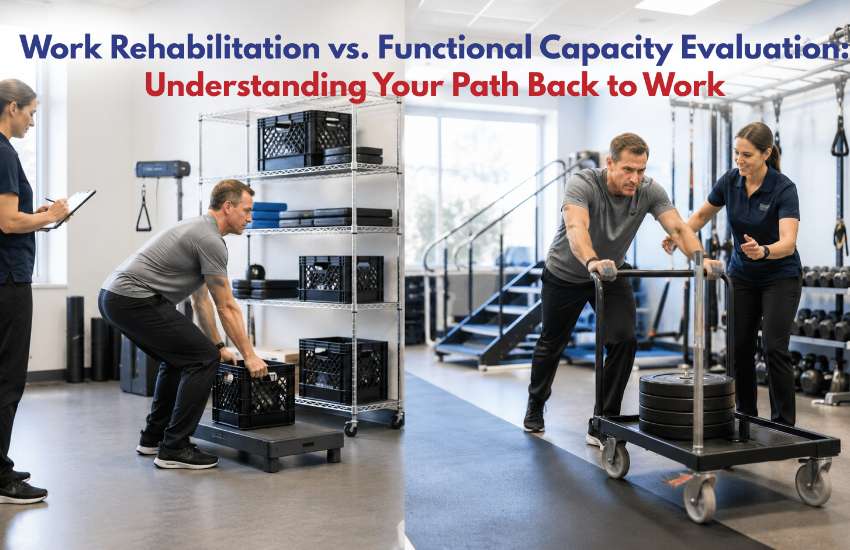
How do you know when an injured worker is truly ready to return to work?
After a workplace injury, both workers and their care teams want to ensure that returning to job duties is safe, effective, and sustainable. In the Washington workers’ compensation system, two tools frequently discussed are Functional Capacity Evaluations (FCEs) and Work Rehabilitation.
While both provide valuable insights into an injured worker’s physical abilities, they serve completely different purposes. Understanding how they differ can help injured workers, physicians, nurse case managers, claim adjusters, and vocational counselors make informed return-to-work decisions.
What Is a Functional Capacity Evaluation (FCE)?
A Functional Capacity Evaluation (FCE) is a structured, in-depth evaluation designed to measure an individual’s ability to perform work-related tasks and activities of daily living such as getting dressed, cleaning living spaces, and sitting at the table for dinner.
Purpose: It captures a practical assessment when a claim needs an evaluation of current capacity.
- Duration & Format: An FCE is typically a one-time evaluation lasting several hours (often 4 to 6 hours) conducted under structured testing conditions.
- What It Measures: Testing may assess lifting, carrying, pushing, pulling, positional tolerance, grip testing, walking, standing, and other functional tasks.
- Considerations: Because an FCE involves several hours of structured and potentially demanding physical testing, some workers may not yet have the activity tolerance to complete prolonged testing without experiencing a temporary increase in symptoms or fatigue. This can be particularly relevant for workers who are still building their strength, endurance, or tolerance for sustained activity.
- Outcomes: It provides a one-day snapshot of what the worker demonstrates during that specific evaluation session.
What Is Work Rehabilitation?
Work Rehabilitation – often referred to as work conditioning or work hardening is a structured, individualized return-to-work program. At PhysioWorks, it is described as “training camp for the injured industrial athlete”.
- Purpose: Services Included: It uses a multidisciplinary approach combining physical therapy and occupational therapy services.
- Activities: Treatment includes progressive strengthening, cardiovascular conditioning, material handling, body mechanics training, task pacing, and job-specific work simulation.
- Monitoring Over Time: The worker is observed across repeated, progressive sessions to evaluate activity tolerance, fatigue, recovery, and consistency.
- Documentation: At the end of the program, a Capacity Summary Form is completed to document demonstrated abilities to the attending provider and vocational counselor.
Side-by-Side Comparison
| Feature | Functional Capacity Evaluation (FCE) | Work Rehabilitation |
| Primary Purpose | Measure current functional capacity | Build work tolerance and job readiness |
| Program Length | Single evaluation session | Progressive program over multiple sessions/weeks |
| Session Duration | One visit lasting several hours (4–6 hours) | Repeated visits progressing toward full shift tolerance |
| Focus | Objective testing and capacity measurement | Treatment, job simulation, conditioning, & objective progress |
| Testing vs. Treatment | Testing snapshot | Active rehabilitation treatment and training |
| Data Collection | Single-day snapshot | Ongoing multi-session data points |
| Job Simulation | Standardized functional task testing | Progressive, real-world work simulation |
| Functional Improvement | Measures existing performance (no treatment) | Actively builds measurable strength, stamina, and confidence |
| Final Documentation | FCE Evaluation Report | Capacity Summary Form |
Why an FCE Is a Snapshot
An FCE delivers valuable information, but it captures what a worker can do on one specific day under controlled testing conditions.
A snapshot may not reveal how a worker responds over extended periods. Factors that fluctuate day-to-day such as fatigue, symptom response, pain, and recovery times might not be fully evident during a single 4-to-6 hour evaluation window.
- Key Takeaway: An FCE measures what a worker can do on a single day, while Work Rehabilitation helps build, progress, and observe functional capacity over multiple treatment sessions.
Why Work Rehabilitation Provides a Broader Picture
Work Rehabilitation provides a broader, more practical view of a worker’s capacity because it combines active treatment, job simulation, progression, and final functional documentation.
Rather than asking only, “What can this worker do today during testing?” Work Rehabilitation asks, “What can this worker consistently tolerate as they progress toward the demands of their job?”
By observing the worker across multiple treatment sessions, the clinical team can track:
- Progressive lifting and material handling capacity
- Full-shift stamina and activity tolerance
- Fatigue patterns and day-to-day recovery
- Consistency in movement quality and body mechanics
- Movement confidence and reinjury anxiety
Which Service Do You Need?
Both tools support return-to-work decision-making and can complement one another depending on the needs of the claim.
An FCE May Be Most Appropriate When:
- The claim requires a structured, one-time baseline assessment of current functional capacity.
- An objective snapshot of physical abilities is needed for claim management or vocational assessment.
Work Rehabilitation May Be Most Appropriate When:
- The worker has progressed in physical therapy but is not yet ready for the physical demands of full-duty work.
- The worker needs job-specific conditioning, material handling, or endurance training before returning to a demanding role.
- The attending provider, vocational counselor, or claim manager needs multi-session data on how the worker tolerates progressive activity over time.
Frequently Asked Questions
Can I return to work after an FCE?
An FCE measures your demonstrated capacity on the day of testing. Your attending provider reviews the FCE findings alongside your overall medical status to help make return-to-work decisions or assign work restrictions.
Is Work Rehabilitation treatment or testing?
Work Rehabilitation is an active treatment program. While the clinical team continually observes and documents your performance, the program focuses on progressive strengthening, job simulation, and conditioning.
Does Work Rehabilitation include an FCE?
No. Work Rehabilitation is an ongoing rehabilitation program. However, at the end of the Work Rehabilitation program, a Capacity Summary Form is completed to summarize your demonstrated abilities.
Which one is more accurate?
Neither is inherently “more accurate” they answer different questions. An FCE measures one-day performance under standardized test conditions while Work Rehabilitation evaluates functional capacity and endurance across multiple sessions of progressive activity.
Will workers’ compensation cover these services?
Work Rehabilitation and evaluation services fall under medical costs in workers’ compensation claims and are paid by the insurer when authorized and determined to be medically appropriate. If you have specific claim coverage questions, consult your attending provider or claim representative.
How long does Work Rehabilitation last?
The length and schedule of Work Rehabilitation are individualized based on medical appropriateness, worker response, work status, and job goals. Session times and demands gradually progress as the worker builds capacity.
Conclusion
Both Functional Capacity Evaluations and Work Rehabilitation play critical roles in helping injured workers transition back to the workplace safely. While an FCE provides an essential one-day snapshot of functional performance, Work Rehabilitation offers an active, progressive environment to rebuild strength, endurance, and confidence while capturing multi-session functional data.
If you are recovering from a work injury and want to learn more about how Work Rehabilitation or Functional Capacity Evaluations can support your return to work, contact the team at PhysioWorks.
About the Authors

Danny Beeman, MPT, CFCE
President/Owner

Karl Lange, PT, CEEAA
Clinical Director/Owner