Improving After a Work Injury but Not Ready for Full Duty?
Many injured workers make excellent progress during their initial recovery. Your pain improves, movement gets easier, your baseline strength returns, and daily activities at home start to feel manageable again.
Even with that fantastic progress, you might still find that you are not ready for full duty tasks. Feeling better during a standard, hour-long clinic visit is a great milestone, but it is vastly different from tolerating the heavy lifting, repetitive movements, and stamina required for an eight-hour shift.
If you find yourself in this exact position—eager to get back to your job but still physically limited—it is the perfect time to consider work rehabilitation after PT.
Why This Is Not Just “More PT”
It is a common misconception that work rehabilitation is simply adding another month of traditional work injury physical therapy. While general therapy does an incredible job of healing the specific injured body part and restoring basic function, work rehabilitation shifts the entire focus toward comprehensive job readiness.
Instead of only assessing whether your injury is structurally improving, a return to work rehab program asks practical, real-world questions:
- Can you lift, carry, push, and pull your required job loads safely?
- Can you maintain sustained, awkward positions over several hours?
- Can you repeat demanding tasks consistently without a spike in symptoms?
- Do you have the stamina to tolerate a full shift at a realistic, productive pace?
Real-World Recovery Examples
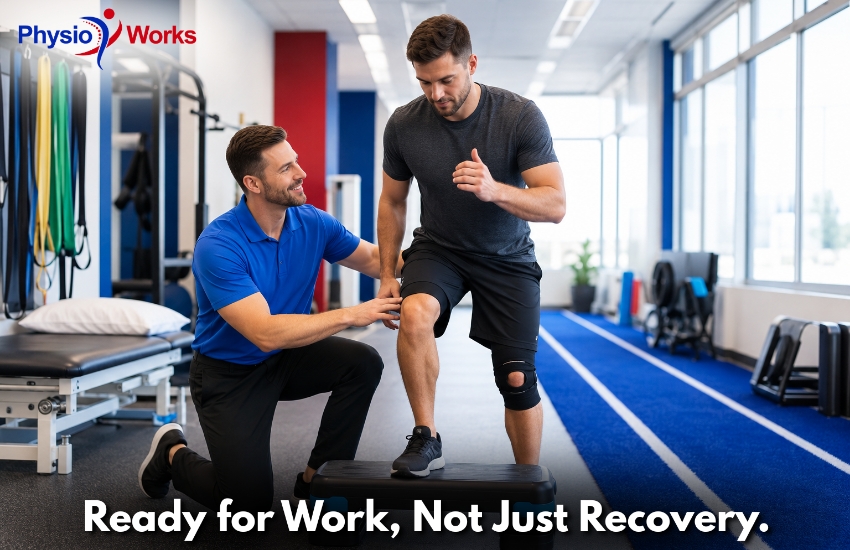
- Meniscus Repair Recovery: A worker may walk without a limp and have minimal daily pain, but they still need to build structural tolerance for repeated squatting, kneeling, ladder climbing, and prolonged standing before stepping back onto a job site.
- Lumbar Spine Recovery: A worker who responds beautifully to a spinal injection may feel great at rest, but they still require dedicated trunk endurance, targeted lifting conditioning, and proper body mechanics training to protect their back during a full workday.
The Right Step at the Right Time
Work rehabilitation is most effective when you are medically appropriate for physical progression and highly motivated to get back on the job. Rather than waiting until your recovery stalls out completely, using a structured program proactively helps you safely transition from clinic-based care to work-specific readiness.
At PhysioWorks, we treat this phase as training camp for the injured industrial athlete. It provides a safe, highly supervised environment where physical therapy and occupational therapy work together to build your strength, endurance, and measurable work capacity.
Practicing your actual job simulation tasks under the watchful eye of clinical experts does more than just condition your body—it systematically builds your mental confidence, removing the fear of reinjury that many workers experience.
Helping Your L&I Claim Team Understand Your Abilities
Navigating a Washington workers’ compensation claim requires clear, objective data. Entering a dedicated work conditioning or work hardening program gives your entire claim team—including your attending provider, vocational counselor, and claim manager—a clear picture of your actual physical performance over multiple sessions.
Because you are observed across repeated visits, the treatment team can track how your body responds to fatigue and progressive strengthening over time. At the conclusion of your program, a Capacity Summary Form is completed. This official document outlines your safely demonstrated abilities, giving your doctor and vocational counselor the exact data they need to make definitive, safe return-to-work decisions or to map out alternative vocational options.
If you are recovering from a work injury and want to know whether Work Rehabilitation may be appropriate, contact PhysioWorks. We provide physical therapy and occupational therapy services focused on helping injured workers safely return to work.
About the Authors:

Danny Beeman, MPT, CFCE
President/Owner

Karl Lange, PT, CEEAA
Clinical Director/Owner