
Why PT May Not Be Enough Before Returning to a Demanding Job
Feeling Better Is Not Always the Same as Work-Ready
Finishing up your initial rounds of physical therapy after a work injury is a massive milestone. Your pain has likely minimized, your basic range of motion has improved, and your everyday tasks around the house feel manageable again. It is completely natural to celebrate this progress, but you might still feel a lingering sense of anxiety about your upcoming return to work and demanding job job tasks.
The truth is, feeling better at home is entirely different from being ready for a full-duty workday. A typical physical therapy visit lasts about 45 to 60 minutes in a highly controlled clinic environment. While that session is essential for restoring core mobility and strength, it cannot replicate the grueling, repetitive strain of an 8-hour shift. For industrial athletes—such as warehouse workers, construction laborers, delivery drivers, and nurses—doing well in a short appointment does not automatically mean you can safely tolerate heavy lifting, carrying, bending, climbing ladders, or crouching for hours on end. There is a distinct line between “clinic tolerance” and true “work tolerance.”
The Gap Between Therapy and Full Duty
Traditional physical therapy focuses heavily on the initial stages of healing and restoring basic bodily function. Work rehab is different because it shifts the entire spotlight toward overall work capacity.
Instead of just checking if an injured muscle or joint is structurally healing, a customized program asks highly practical, real-world questions:
- How many pounds can this worker safely lift and carry repeatedly without a flare-up?
- How long can they stand, walk, or hold an awkward position before fatigue sets in?
- Can they safely handle production-line pacing and full-shift physical demands day after day?
Entering a structured program for work hardening or work conditioning after PT after PT is specifically designed to bridge this exact gap. It acts as the ultimate transition, ensuring you don’t go straight from a treatment table right back into a high-risk environment before your body is genuinely capable of handling the pressure.
Building True Work-Specific Stamina
Physically demanding jobs require a specialized type of physical conditioning. To prepare you for the clock, PhysioWorks combines physical therapy and occupational therapy to build comprehensive, job-specific physical endurance.
Your structured work rehab schedule will move past basic gym exercises and focus directly on:
- Progressive Conditioning: Targeted cardiovascular and muscular endurance training modeled after the length and pacing of your actual workday.
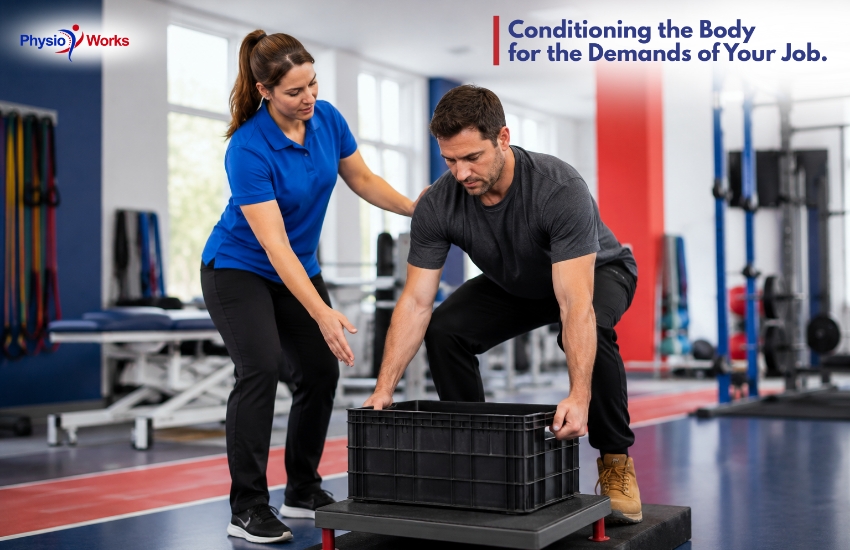
- Job Simulation Therapy: Real-world practice involving material handling—such as lifting, carrying, pushing, and pulling real loads—using proper mechanics in a highly supervised setting.
- Positional Stamina: Gradually expanding your ability to tolerate sustained positions like kneeling, squatting, bending, and reaching overhead.
- Work Pacing & Safety Education: Teaching you vital strategies to manage fatigue, protect your body, and minimize the risk of a painful setback.
The ultimate goal is to build true work tolerance so your body can keep up with the daily operational rhythm of your industry.
Tracking Real Performance Over Time
Another major advantage of a dedicated work conditioning and hardening program is that you are observed across multiple, consecutive sessions. This allows our clinical team to monitor patterns that simply cannot be caught during a single, brief medical evaluation. We closely track your symptom response, consistency, physical effort, and how well your body recovers from fatigue from one day to the next.
This continuous tracking provides clear, objective evidence of your functional capacity. At the conclusion of your program, our treatment team documents your safely demonstrated physical milestones on a Capacity Summary Form. This formal document gives your attending provider, claim manager, and vocational counselor the precise data they need to make definitive, safe return-to-work decisions or build an accurate modified duty plan. It takes the guesswork out of your claim and gives you the ultimate peace of mind that you are truly ready to return to your job safely.
About the Authors

Danny Beeman, MPT, CFCE
President/Owner

Karl Lange, PT, CEEAA
Clinical Director/Owner