Work Conditioning vs. Work Hardening vs. Work Rehabilitation
Why the Terms Can Be Confusing
If you are recovering from a work injury, navigating the healthcare system and workers’ compensation claims can feel overwhelming. It certainly does not help when you hear entirely different terms thrown around by different professionals. Your doctor might tell you that you need a program for work conditioning, a lawyer or vocational counselor might talk about work hardening, and your L&I claim manager might officially refer to the process as work rehabilitation.
Trying to decipher this industry jargon while dealing with physical pain and trying to protect your livelihood is stressful. However, it helps to know that while subtle technical distinctions exist, all of these terms generally point toward the exact same foundational goal: helping an injured worker rebuild their physical capacity so they can get back to their job safely.
Why We Use “Work Rehabilitation”
At PhysioWorks, we focus primarily on the comprehensive term work rehabilitation. We do this because it directly aligns with the official Washington State Department of Labor & Industries terminology. However, we regularly use the terms work conditioning and work hardening during our patient education, consultations, and treatments because we know that workers, physicians, and claim stakeholders frequently search for and use those phrases.
For you as a patient, the exact label or legal phrasing matters far less than your real-world outcomes. The most vital question you should focus on is whether your treatment plan is successfully progressing your strength, endurance, and comfort levels back toward a safe return to work.
What Do These Programs Actually Include?
To break down the technical differences clearly: standard work conditioning historically focuses heavily on the physical aspects of conditioning, such as restoring systemic muscle strength, cardiovascular endurance, and foundational mobility. On the other hand, work hardening traditionally expands into a highly comprehensive, multi-disciplinary approach that incorporates heavy task simulation, specialized occupational therapy, and structural strategies to build overall work endurance.
Under the overarching umbrella of a Washington L&I work rehab program, your care at PhysioWorks will be completely individualized. Depending on your exact injury and the physical baseline required for your job, your daily training routine may include:
- Progressive Strengthening: Targeted exercise plans to build up the core and limb strength needed to protect your joints under stress.
- Cardiovascular Conditioning: Systematically improving your cardiovascular stamina so you can endure a grueling shift without experiencing severe fatigue.
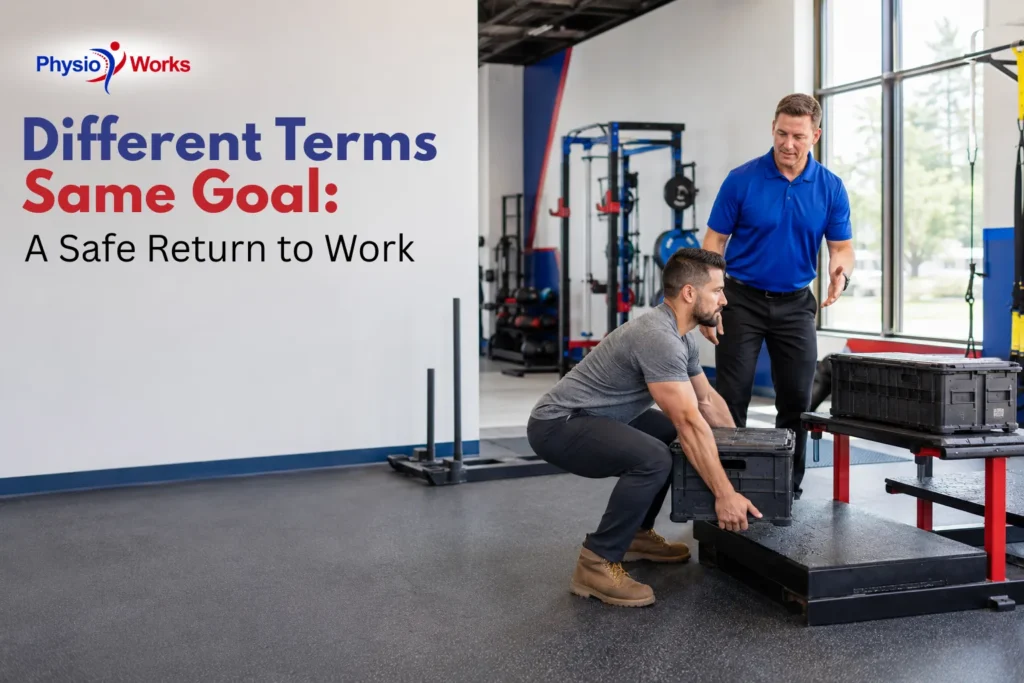
- Material Handling & Job Simulation: Simulating specific workplace requirements like lifting heavy boxes, pushing loaded carts, or pulling equipment in a supervised setting.
- Body Mechanics & Pacing: Learning proper lifting techniques and pacing strategies to manage symptoms and dramatically reduce your risk of a setback or reinjury.
Because no two occupations are identical, a construction worker moving heavy timber will follow a fundamentally different progression track than a healthcare worker transferring patients or a warehouse employee operating machinery.
The Core Goal: Your Return to Work
At PhysioWorks, we describe work rehabilitation as a focused training camp for the injured industrial athlete. Just as a professional competitor utilizes a sports-medicine team to prepare for game-day performance, you deserve a structured, measurable environment to practice the real-world physical demands of your daily work shifts.
Ultimately, the primary objective is to facilitate a seamless return to your original job without long-term physical limitations whenever safely possible. However, if your injury changes things and a full-duty return to that exact role is not immediately in the cards, completing this specialized program remains incredibly valuable.
The multiple data points tracked during your sessions culminate in a final Capacity Summary Form. This document clearly details your safely demonstrated physical capabilities to your treating provider and vocational counselor, maximizing your vocational opportunities and helping you confidently take the next steps toward a secure, healthy professional future.
Ready to Safely Transition Back to Work?
If you are recovering from a work injury and want to know whether Work Rehabilitation may be appropriate, contact PhysioWorks. We provide physical therapy and occupational therapy services focused on helping injured workers safely return to work.
PhysioWorks Kent
Located inside Physio Health Clinic,
319 Washington Ave S Kent, WA 98032
Call/Text: (253) 264-0093 / (253) 850-9780
Fax: (253) 850-6445
PhysioWorks Silverdale
9399 Ridgetop Blvd NW #101Silverdale, WA 98383
Call/Text: (360) 583-4539 / (360) 516-1210
Fax: (833) 287-7170
Website
About the Authors

Danny Beeman, MPT, CFCE
President/Owner

Karl Lange, PT, CEEAA
Clinical Director/Owner