
Trigger Finger: Symptoms and Treatment Options
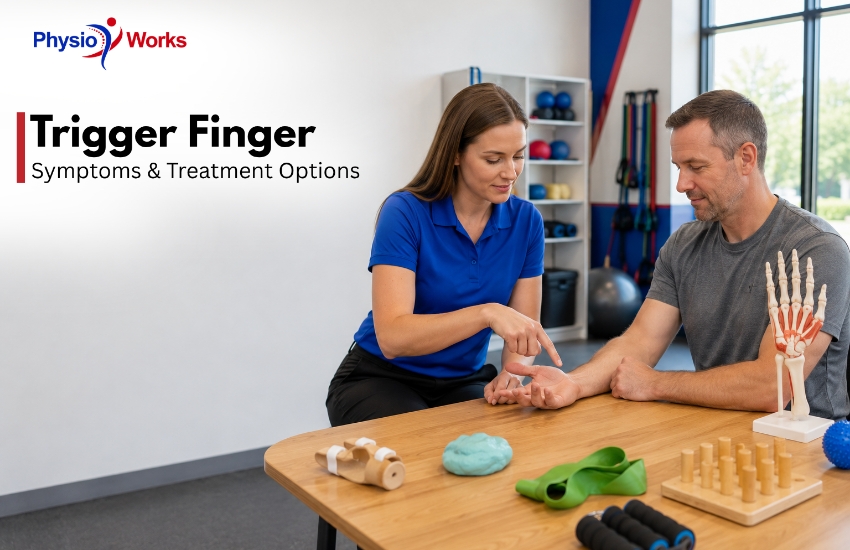
Have you ever gone to straighten your hand, only to find that one of your fingers stays bent? Then, with a sudden, painful click, it snaps back into place. If this sounds familiar, you may be experiencing a common condition known as trigger finger.
When your fingers catch, snap, or lock, completing basic daily tasks can become highly frustrating. You use your hands for almost everything, from holding your morning coffee to typing at work or gripping a steering wheel. Fortunately, specialized care can help you find relief. Understanding trigger finger symptoms and treatment options is the first step toward restoring smooth, pain-free movement to your hand.
What Is Trigger Finger?
The medical name for trigger finger is stenosing tenosynovitis. To understand this condition, it helps to think of how your hand works as a simple mechanical system of cords and pulleys.
The tendons in your fingers act like long pulling cords. When the muscles in your forearm contract, they pull these tendons to bend your fingers. To keep these cords from bowing out when you make a fist, they pass through a series of small, protective tissue tunnels called pulleys. The first of these tunnels, located right where your finger meets your palm, is called the A1 pulley.
Trigger finger occurs when a size mismatch develops between the tendon and this tunnel. Over time, the tendon can become thick, irritated, or develop a small nodule (a swollen bump). Because of this inflammation, the tendon can no longer glide smoothly through the tunnel. Instead, it catches at the opening of the A1 pulley, causing your finger to snap or lock in a bent position. For a deeper dive into the anatomy and mechanics of this condition, you can review the clinical condition details from the American Academy of Orthopaedic Surgeons.
Common Causes of Trigger Finger
In many cases, trigger finger develops gradually without a single, clear injury. However, clinical research shows that certain repetitive movements and physical traits make you much more likely to develop this structural problem:
- Repetitive Hand Use: Performing tasks that require repetitive gripping, heavy pinching, or holding tools tightly over long periods can irritate the tendon lining.
- Underlying Medical Conditions: People with certain chronic health conditions have a much higher risk of developing a swollen tendon sheath. This includes individuals managing diabetes, rheumatoid arthritis, or amyloidosis.
- Gender and Age: Clinical studies show that trigger finger is most common in adults between the ages of 40 and 60, and it occurs significantly more often in women than in men.
Signs and Symptoms of Trigger Finger
The signs of trigger finger typically start slowly and worsen over weeks or months. Recognizing the progression of these symptoms can help you take action before your joint becomes severely stiff.
Early Warning Signs: Tenderness and Popping
In the early stages, you may notice a tender, painful lump at the base of the finger or thumb on the palm side of your hand. Your hand might feel uncomfortably sore when you attempt to grip objects. As you bend or try to extend the digit, you may feel or hear a distinct clicking, popping, or catching sensation inside the joint.
Advanced Symptoms: Locking and Stiffness in the Morning
As the tendon nodule grows larger, the finger can get completely stuck in a bent position. You may even have to use your opposite hand to physically push and straighten the digit back out. These symptoms are usually much worse after periods of rest, which is why patients frequently report severe joint stiffness and locking in the morning. Rhythmic, gentle movement during the day can sometimes help the tendon glide a bit better.
How Hand Therapy Can Help You Recover
Many patients worry that a locking finger means they need surgery or a painful injection right away. However, the majority of cases respond remarkably well to conservative, non-surgical treatment. Enrolling in a specialized hand therapy program provides an evidence-based pathway to reduce tissue friction and restore full function.
A certified hand therapist understands the biomechanics of your upper extremity. Rather than simply treating the single finger, they look at your entire hand function. Your therapist will perform an evaluation to design a customized treatment plan that protects your irritated joints while keeping your surrounding muscles strong and mobile.
Non-Surgical Treatment Options
The primary goal of hand therapy is to reduce the swelling around the tendon so it can slide freely through the A1 pulley again. Your therapist will utilize a combination of non-surgical strategies:
1. Activity Modification and Ergonomics
Resting the overtaxed hand is essential to give the internal swelling time to go down. Your therapist will look at your regular work setups and teach you ergonomic adjustments to avoid hard, repetitive pinching or gripping. They may suggest tool modifications or adaptive equipment to reduce the structural load on your hand.
2. Custom Orthotic Finger Splinting
Splinting is one of the most effective non-surgical tools for trigger finger. Your therapist can custom-fabricate a small, lightweight splint to hold the base joint of the finger straight while you sleep. This limits the repetitive pulling and friction on the inflamed nodule, allowing the tissues to calm down overnight.
3. Gentle Stretching and Tendon Gliding Exercises
To prevent long-term joint tightness, your therapist will introduce gentle trigger finger exercises. You will learn specialized movements called tendon glides. These specific exercises are designed to gently pull the tendon through its tunnel at a controlled pace, safely maintaining your range of motion without increasing internal friction.
When to Seek Professional Hand Rehabilitation
Ignoring a catching finger can cause chronic stiffness to build up within the joint over time. You should seek help from a professional therapist if you notice any of these structural warning signs:
You notice a progressive loss of grip strength or develop localized hand weakness from limiting your movements to avoid pain.
You experience a severe loss of daily function, making it difficult to complete simple tasks like buttoning clothing, holding a pen, or working.
Your finger becomes completely stuck in a bent position and cannot be straightened even when using your other hand.
About the Authors

Danny Beeman, MPT, CFCE
President/Owner

Karl Lange, PT, CEEAA
Clinical Director/Owner