


Suffering from Sciatica? Physical Therapy Has Solutions
Are you dealing with burning, shooting pain that radiates from your lower back into your foot? This is the hallmark of sciatica, an often misunderstood nerve condition. While sciatica can be extremely painful–and often debilitating–you don’t need to despair. Physical therapy at PhysioWorks has solutions to help you find relief.
Sciatica is named for the sciatic nerve, one of the primary nerves in your body. Its roots are located in your lower back, and the nerve runs through the buttocks and down the back of the leg into the foot. While some people will refer to any pain in the lower extremities as sciatica, the term only refers to symptoms that stem from the sciatic nerve.
To help you better understand sciatica and what physical therapy can do to help, we want to share a case study of one of our patients, a 55-year-old woman we’ll call Sally. If you suspect you may have sciatica, schedule an appointment with us today!

Exploring Sally’s Symptoms
Sally’s pain was quite severe. She mostly felt it in her right leg–a shooting, electric pain that seemed to split down the back of her calf muscle. Occasionally, she felt a dull ache in her lower back, but her leg pain caused her the most trouble. It was worse when she was lying down or had to be on her feet for long periods.
The other issue–and the reason she ultimately found her way to our clinic–was that she also experienced a persistent pins and needles sensation down the back of her leg, which alarmed her. As her leg began to feel weak and heavy, she knew her symptoms weren’t going away on their own.
Identifying the Root Cause
Our physical therapists listened to Sally explain her symptoms and then performed a comprehensive physical evaluation to assess her strength, range of motion, and key areas. We also took a complete health history.
While we could confidently say Sally had sciatica, it was more important for us to determine why she had it. The truth is that sciatica isn’t so much a condition in and of itself as a sign that something is wrong with the sciatic nerve–usually that it’s been compressed or irritated.
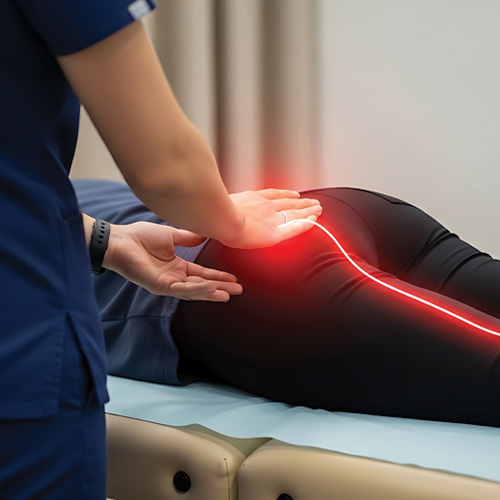
So we dug a little deeper and confirmed what we suspected: Sally had developed a herniated disc. Herniated discs occur when the cushiony material between the spine’s vertebrae bulges outward. In Sally’s case, that bulging disc was pressing against her right sciatic nerve root, sending symptoms radiating down the nerve itself.
Addressing the Issue
Once we knew Sally’s sciatica had developed due to a herniated disc, we were able to create a personalized treatment plan to address it. Fortunately for Sally, physical therapy is an excellent way of resolving pain from a herniated disc.
We began with acute pain management, particularly through manual therapy techniques like spinal mobilizations (guiding the back through its current range of motion) or soft tissue manipulation (a massage-like manipulation of the muscles and other tissue).
These techniques offered acute pain relief so Sally could begin working on a personalized exercise program. At first, we focused on gentle back stretches and encouraged Sally to walk around her block a few times a week.
But as she improved, we began incorporating core strengthening exercises, too. Why core strength? Well, your core muscles support and stabilize the spine; the stronger they are, the more support they offer the lower back. We guided her through a progressive series of exercises, increasing the intensity as she got stronger.
Finally, we gave Sally the tools she needed to prevent future herniated discs. Namely, we encouraged her to stay active, maintain her spine mobility, and continue strengthening her core. We also showed her proper lifting technique so she would be less likely to injure herself.
Find Your Own Sciatica Relief Today
If you have sciatica symptoms, you don’t have to suffer! The team at PhysioWorks can help you pinpoint the cause of your sciatica and find a solution that works for you. Call us today to get started.

Real Results. Real Recovery.
Nothing speaks louder than the experience of our patients. Here’s what one recent patient had to say about their journey at PhysioWorks.
Exercise of the Month
SEATED SCIATIC NERVE TENSIONER
Sit in a chair with one foot flat on the ground and the foot on the side you want to work flexed with your toes pointing towards your face. Lift one lower leg by lightly contracting the upper thigh while simultaneously lowering your head, slowly tucking your chin towards your chest and exhaling. Slowly return to start.
3 Sets, 10 Reps. (Materials needed: chair)
Exercises are for educational purposes only and should be performed under the guidance and supervision of a PhysioWorks staff member/therapist

Ingredients
- 1 (32-ounce) can whole tomatoes, drained
- 1 cup fresh basil leaves
- 4 tablespoons extra-virgin olive oil
- 6 cloves garlic, peeled
- Kosher salt
- Freshly ground black pepper
- 2 large French baguettes, sliced into 1-inch slices (about 36 slices)
- 1½ pounds fresh mozzarella cheese, sliced ¼-inch thick
Directions
- Preheat oven to 375°F.
- In a food processor, combine the drained tomatoes, basil, olive oil, and 2 garlic cloves. Pulse until smooth but still slightly chunky.
- Season the tomato mixture with kosher salt and freshly ground black pepper.
- Arrange the baguette slices on a baking sheet and toast for about 3 minutes.
- Rub the toasted side of each slice with the remaining garlic cloves.
- Top each slice with a piece of fresh mozzarella and return to the oven for about 45 seconds, just until the cheese softens.
- Spoon about 1 tablespoon of the tomato mixture onto each slice.
- Transfer to a serving platter, garnish with fresh basil leaves, and serve immediately.


Everyday Tasks Start With Healthy Hands
Dealing with hand pain can make even simple daily tasks frustrating—especially at work. Whether you're typing on a computer, gripping tools, or recovering after surgery, healthy hands are essential for staying productive and independent.
Hand therapy at PhysioWorks is designed to reduce pain, restore movement, and rebuild the strength and coordination you need to confidently return to work and everyday life.
What Is Hand Therapy?
Hand therapy is a specialized form of rehabilitation for the hands, wrists, forearms, elbows, and shoulders. Your therapist performs a detailed evaluation and creates a personalized treatment plan based on your symptoms, daily activities, and recovery goals.
Restore Movement
Gentle joint and soft tissue techniques, scar management, and swelling control help improve mobility while reducing stiffness and discomfort.
Rebuild Strength
Targeted exercises improve grip strength, dexterity, coordination, and fine motor skills so everyday tasks become easier and more comfortable.
Return to Daily Life
Custom splints, ergonomic education, and activity modification help protect healing tissues while allowing you to safely return to work and the activities you enjoy.
Follow Us on Social Media!
Staff Spotlight

Danny Beeman
CEO, MPT, CFCE, PGAP

Karl Lange
PT, CFCE, Clinic Director

Luda Moskvich
Lead PTA, COEE

Alicia Ables
PTA, CES




Iryna Hrytsyuk
COTA, Industrial Rehabilitation Supervisor, CI

Natalia Zhuk
COTA/L

Leah Salius
Administrative Supervisor

Michaela Caragiorgio
Billing Supervisor

Sherlyn Dagohoy
Patient Care Coordinator

Jeric Tumaob
Patient Care Coordinator

Michael Kovach
Doctor of Physical Therapy


Christin Hitchcock
Physical Therapist


Cara Thomas
Patient Care Coordinator